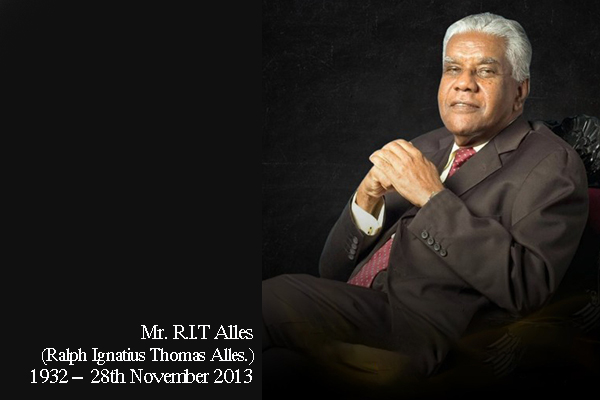
Thirteen years after his passing, the remarkable life of Ralph Ignatius Thomas Alles reminds Sri Lanka that the greatest achievement of an educator is not the institutions they build, but the lives they transform.
There was once a schoolboy who had fallen behind on his school fees. His father had died of a heart attack, leaving behind four children and a mother struggling to support her family. In desperation, she had even sold her sewing machine to feed her children. When the principal summoned the boy, he stood before him trembling, uncertain of what would follow. But instead of reprimanding him, the principal listened. As the boy explained his family’s circumstances, the man’s eyes filled with tears. He personally paid the outstanding school fees. That principal was Ralph Ignatius Thomas Alles. The incident, recalled by a former pupil in a tribute published in The Sunday Times in 2013, captures the character of a man who understood that behind every school uniform was a child with a story, a struggle and a dream. On 28 November 2026, as Sri Lanka marks the 13th death anniversary of Mr R.I.T. Alles, it remembers not only a distinguished educationist, but a man who made thousands of children feel that they belonged.
From a classroom to a national legacy Born on 3 October 1932 in Galle, Alles received his education at St. Aloysius’ College, Galle, and St. Anthony’s College, Kandy, before receiving further training at the Cambridge Institute of Education. He began his career in teaching and served at Royal College, Colombo, where his commitment extended beyond the classroom to cricket, athletics, cadetting and the welfare of fellow teachers. In 1967, at the age of 34, he accepted a challenge that would change the course of his life and leave a lasting mark on Sri Lankan education. On 10 February that year, D. S. Senanayake College was established on land popularly known as ‘Koombi Kale’. There were no generations of old boys to support the school, no established traditions to inherit and few of the facilities associated with a leading educational institution. Yet there was determination. Bogoda Premaratne, the former principal of Royal College who nominated Alles for the position, recalled that even while establishing the new school, Alles continued conducting afternoon mathematics lessons for his Royal College pupils and training cadets preparing for camp. Those students, in turn, helped him clear the overgrown land on which their teacher was building a new school. In his autobiography, My Life, Alles also recalled the early days when meals were prepared beneath a tree and eaten on plantain leaves. From these humble beginnings emerged one of Sri Lanka’s most respected state schools.
A principal who called his students ‘Putha’ For generations of D. S. Senanayake College students, the word ‘Putha’ carried a special meaning. It was how their principal addressed them, not merely as pupils under his authority, but as children entrusted to his care. Senior and junior students addressed one another as ‘Aiya’ and ‘Malli’, nurturing a sense of brotherhood that extended beyond the school gates. Discipline was important to Alles, but so was compassion. He understood that respect could be earned through kindness as much as through authority. His influence often continued into adulthood. In a moving tribute following his death, former pupil Dr Thushara Rodrigo recalled how Alles had attended his graduation, given his blessings when he chose his life partner and been present when he became a father. The principal he had first encountered as a five year old schoolboy eventually became ‘Ralph Seeya’ to his children. It was a relationship that had outlived classrooms, examinations and school assemblies.
Teaching a nation to live together Perhaps one of Alles’ most enduring contributions was his commitment to unity in diversity. At D. S. Senanayake College, children from different ethnic, religious and linguistic backgrounds were encouraged to grow together as brothers. Dr Rodrigo recalled how Alles addressed students in Sinhala and English, with teachers providing Tamil translations. Students from different communities were entrusted with leadership positions on merit. In a country that would endure decades of ethnic conflict, these lessons carried a significance far beyond education. Through the school’s motto, ‘Country Before Self’, Alles encouraged generations of young people to recognise their responsibility towards their fellow citizens, irrespective of religion, ethnicity or social standing. His service extended to Zahira College, Colombo, and subsequently to national education administration, serving as State Secretary of Education from 1989 to 1993. In 1997, he established Gateway College in a converted house with just 33 students and eight teachers, extending his educational philosophy into international education while retaining Sri Lankan cultural values.
A teacher until the very end Age may have weakened his body, but it did little to diminish his devotion. Former students remember how Alles continued visiting classrooms even when he needed a wheelchair. His presence was a reminder that educational leadership was not confined to an office. It meant being among children, listening to them and taking an interest in their lives. In an interview in 2007, he expressed his philosophy in words of remarkable simplicity: “My life is not for myself, it is for the children.” He lived by those words until his passing on 28 November 2013, aged 81.
The lessons that remain Thirteen years later, his former pupils are parents, teachers, doctors, entrepreneurs, professionals and leaders in their own communities. Some may have forgotten the mathematics lessons, examination marks or morning announcements. But memories of a familiar voice calling them ‘Putha’, a word of encouragement or an unexpected act of kindness may never have faded. For today’s educators, his life offers a timely reminder that a child’s potential cannot always be measured by examination results. For parents, it is a reminder that character matters as much as academic achievement. And for his students, perhaps the most meaningful way to honour their beloved teacher is to extend to another person the same kindness, understanding and encouragement they once received from him. Schools can be built with bricks and mortar. Institutions can bear a founder’s name. Statues can preserve a likeness. But the greatest memorial to a teacher is a generation of people who live by the values they were taught. By that measure, Mr R.I.T. Alles never truly left us. The teacher may be gone, but his lessons will live on for generations. The post Remembering R.I.T. Alles: The Educator Whose Legacy Continues to Shape Generations appeared first on Newswire.