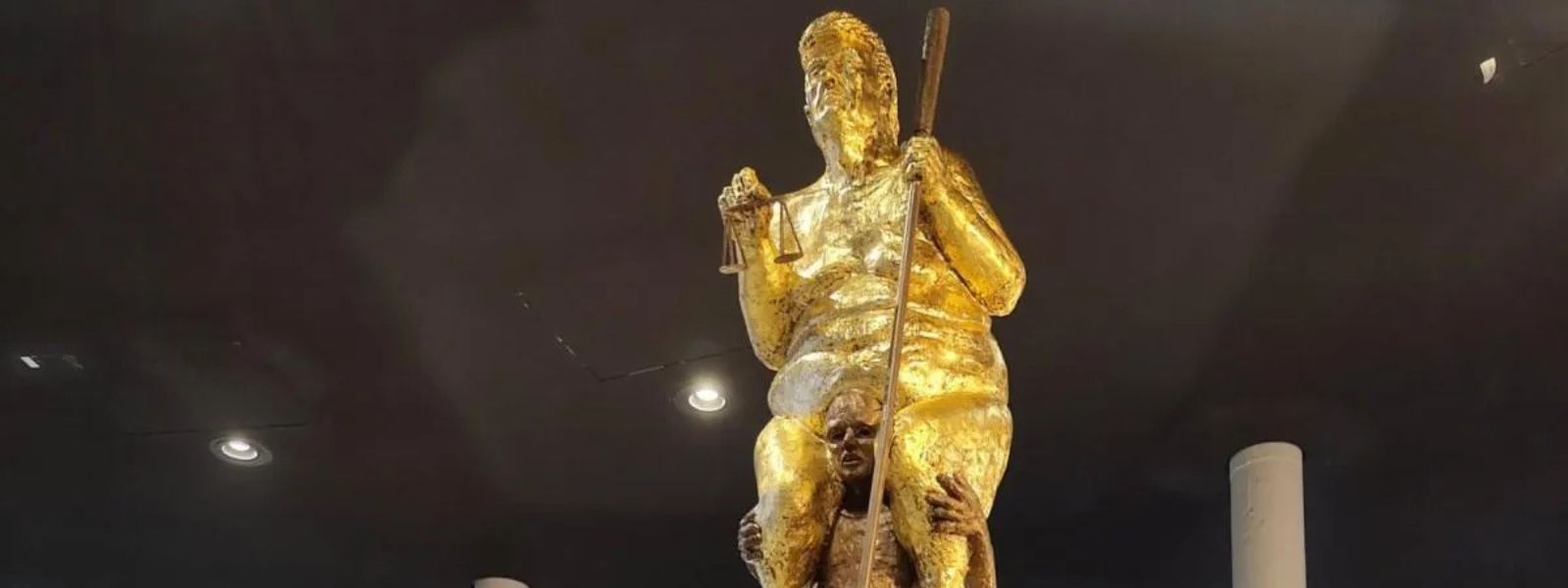
COLOMBO (News 1st); A controversial satirical statue of U.S. President Donald Trump on display inside the European Parliament has reignited debate over where free political expression ends and institutional decorum begins.
The 2.5-metre sculpture, titled "Orange Plague" and also referred to as "King of Injustice," was installed inside the European Parliament complex in Strasbourg, France, as part of a temporary exhibition by Danish artist Jens Galschiot.
The gold-coloured statue depicts Trump seated on the shoulders of a smaller individual while holding an elongated golden club. According to the artist, the sculpture is coated in 23-carat gold and is designed as a political critique of the U.S. President's positions on climate-related issues.
Information cards displayed alongside the exhibit describe the character as a "King of Injustice" who remains seated on the back of another person burdened beneath him. The accompanying text includes the statement: "I would do anything to help him. Except stepping down from his back," while criticizing what the artist views as Trump's approach to addressing climate challenges.
The sculpture has been placed at a busy intersection connecting two European Parliament buildings and is scheduled to remain on display until Thursday.
While political satire and criticism have long been a feature of democratic societies, the location of the exhibit has generated significant discussion.
The controversy is less about whether Donald Trump should be criticized, supporters and critics alike agree that public figures are fair subjects of scrutiny, and more about whether one of the world's most prominent democratic institutions should become a venue for what some observers describe as overt political mockery.
The display has prompted broader questions about the role of legislative institutions in an increasingly polarized political environment.
Danish Member of the European Parliament Per Clausen, who invited the artist, defended the display and dismissed concerns about possible reactions from the United States.
According to Clausen, any political leader unable to tolerate satire and criticism has little place on the global stage.
Trump himself has not publicly commented on the exhibition.
The sculpture has previously been displayed in several European cities and was also exhibited during the COP30 United Nations climate conference in Belém, Brazil.
Yet its appearance inside the European Parliament carries a different significance. Unlike a public square, protest site or art gallery, the European Parliament represents one of the world's largest democratic assemblies, an institution tasked with legislation, diplomacy and engagement with international partners.
The question being raised by some observers is therefore not whether Donald Trump should be criticized, but whether democratic institutions themselves should participate, directly or indirectly, in the kind of political theatre they often condemn in others.